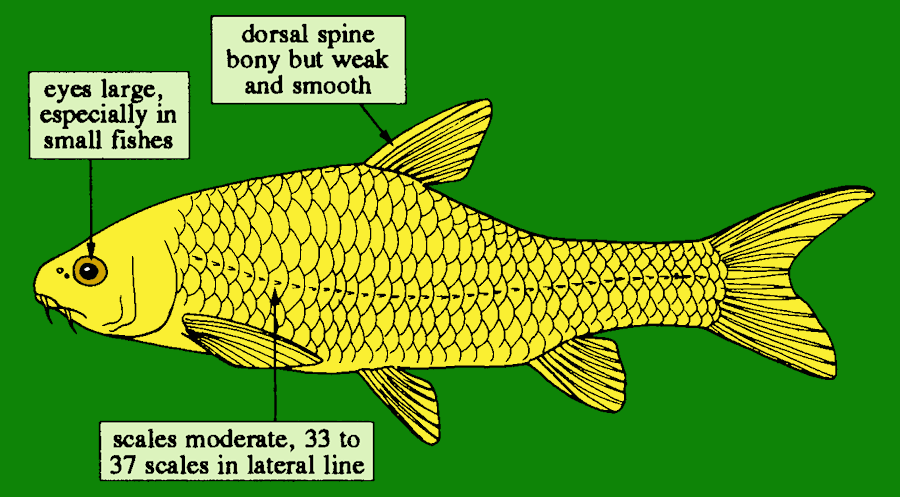
Labeobarbus brevicauda, a large minnow found in Lake Malawi. Colored figure by M.K. Oliver based on drawing by P. Lastrico (FAO), used by permission of the Food and Agriculture Organization of the United Nations. |
Labeobarbus brevicauda (Keilhack, 1908)
by Michael K. Oliver, Ph.D.Labeobarbus brevicauda is one of three "large Barbus" species in Lake Malawi. [It was formerly placed in the genus Barbus and usually known as Barbus eurystomus, which turns out to be a junior synonym of B. (now Labeobarbus) johnstonii, as discovered by Seegers (1995). I thank Denis Tweddle for alerting me to the correct name.] It is endemic to the Lake Malawi basin, including the larger inflowing rivers, which it ascends to spawn (Jackson, 1961). Indigenous names of this species include "Kadyákola," "Kuju," and "Chikasu."
The exceptionally large individual in the photo below at right was seined 31 July 1968 on the beach at Monkey Bay, Malawi, during my

Labeobarbus brevicauda, probable record-sized individual (66 cm, 5 kg) seined 31 July 1968 on Monkey Bay beach. Photo © by M.K. Oliver |
Of the other two large barbs in the lake, L. brevicauda is more likely to be confused with L. johnstonii, with which it shares a subterminal mouth and similar general appearance. They can be distinguished as follows (information from Banister & Clarke, 1980: 489):
- Labeobarbus brevicauda has darkly pigmented scale pockets on the upper part of the body, above the lateral line, giving this region "a series of dark crescents along the body" (see photograph above). L. johnstonii, in contrast, lacks any distinct melanic color pattern.
- L. brevicauda has longer barbels (the anterior one being on average 5.7%, the posterior 5.6%, of standard length, compared to 2.5% and 3.5%, respectively, in L. johnstonii).
- In L. brevicauda there are only four teeth in row I of the lower pharyngeal bone, versus five in L. johnstonii.
Surveys conducted in Malawi during the 1970s "...suggest that B. eurystomus [= L. brevicauda] is relatively uncommon or at least rarely caught" (Banister & Clarke). FishBase agrees that B. eurystomus [= L. brevicauda] "which used to be common is now rare." Interestingly, Denis Tweddle reports that this species "was always fairly rare in the lake, and when a fisherman caught one in the south [he] would sing a song about it and present it to the chief" (personal communication to M.K. Oliver 26 Oct. 2015).
The limited information available to Banister & Clarke from examination of stomach contents indicated that this Labeobarbus feeds on an endemic, detritus-feeding Lake Malawi snail of sandy shores, which these authors referred to as Melanoides turritispira. (I suspect that this is a synonym of Melanoides tuberculata, a name encountered much more frequently.)
The status of Labeobarbus brevicauda has not yet been assessed for the IUCN Red List of threatened species.
The Banister & Clarke (1980) paper, incidentally, is not only a taxonomic revision of those Lake Malawi "Barbus" species (now Labeobarbus, or "Barbus" in the case of B. litamba) that attain a large size. The paper also contains a helpful summary of data on the geological history of Lake Malawi, and a hypothesis of the history of the lake's colonization by fishes.